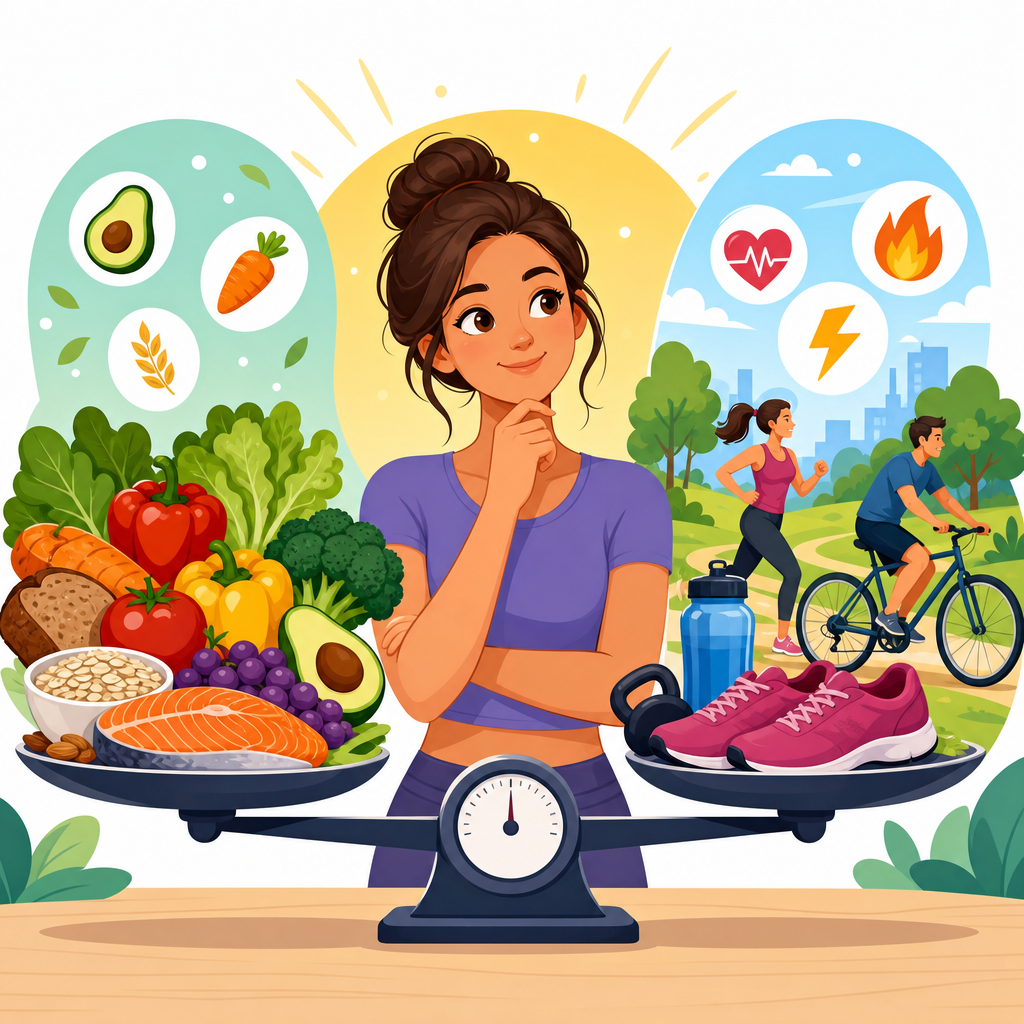
Calories and energy balance sit at the center of every balanced diet because they explain, in measurable terms, how food intake interacts with the body’s energy needs. A calorie is a unit of energy, usually written as kilocalorie on nutrition labels, and it represents the amount of energy food provides when the body digests, absorbs, and uses it. Energy balance describes the relationship between calories consumed and calories expended through basal metabolism, physical activity, digestion, and other physiological processes. When intake closely matches expenditure over time, body weight tends to remain relatively stable; when intake consistently exceeds expenditure, weight usually increases; and when intake stays below expenditure, weight generally decreases.
I have seen this concept transform nutrition from something abstract into something practical for clients who felt overwhelmed by conflicting advice. Once people understand calories and energy balance, they can interpret serving sizes, spot misleading health claims, and make decisions that support weight maintenance, muscle gain, fat loss, athletic performance, or general health. This matters because balanced eating is not only about choosing “good” foods. It is also about eating appropriate amounts, distributing energy across meals, and aligning intake with age, body size, health status, and activity level. Understanding these fundamentals creates the framework for every other nutrition topic, from macronutrients and portion control to meal timing and long-term dietary sustainability.
What calories actually measure in the body
Calories are often treated as the enemy, but in practice they are simply the fuel value of food and drink. The body uses this energy to keep the heart beating, maintain body temperature, support brain function, repair tissue, digest meals, and power movement. Even during sleep, the body continues to require substantial energy. Resting energy expenditure, often estimated through formulas such as Mifflin-St Jeor, usually makes up the largest share of daily calorie use. For many adults, this resting component accounts for roughly 60 to 75 percent of total daily energy expenditure, while physical activity, non-exercise movement, and the thermic effect of food make up the rest.
Food calories come primarily from macronutrients. Carbohydrate provides about 4 calories per gram, protein provides about 4 calories per gram, fat provides about 9 calories per gram, and alcohol provides about 7 calories per gram. These figures are useful, but the body’s response to food is more complex than arithmetic alone. Fiber, food structure, cooking method, and absorption rates can affect usable energy. A bowl of lentils, for example, delivers calories along with protein, fiber, iron, and slow digestion, while a sugary drink may deliver similar calories with less satiety and fewer nutrients. This is why understanding calories is essential, but understanding calories in context is what supports a balanced diet.
How energy balance influences weight, health, and daily function
Energy balance is the long-term outcome of energy in versus energy out. In the clinic and in performance settings, I explain it as a trend rather than a daily scorecard. One high-calorie meal does not create lasting weight gain, and one light eating day does not create meaningful fat loss. Patterns over weeks and months matter more. Positive energy balance supports growth, pregnancy, some phases of athletic training, and recovery from illness, but when it persists unintentionally, it commonly leads to fat gain. Negative energy balance is necessary for fat loss, yet if it is too aggressive or prolonged, it can reduce training output, increase hunger, impair mood, and make adequate nutrient intake harder to achieve.
Energy balance also affects more than body weight. Chronic under-eating can contribute to fatigue, menstrual irregularities, impaired immune function, reduced bone health, and loss of lean mass. Chronic overconsumption can increase the risk of obesity, type 2 diabetes, cardiovascular disease, fatty liver disease, and sleep apnea, especially when excess calories come largely from ultra-processed foods high in added sugar, refined starch, and saturated fat. The balanced diet goal is not just to hit a calorie number, but to match energy intake to needs while obtaining enough protein, essential fats, fiber, vitamins, and minerals. Calories determine energy quantity; food quality determines how well that energy supports health.
Why calorie needs vary so much from person to person
There is no single ideal calorie target because energy requirements differ widely. Age, sex, body size, body composition, genetics, hormone status, occupation, training volume, sleep, stress, medications, and health conditions all influence total daily energy expenditure. A taller person with more lean mass generally burns more calories at rest than a smaller person. Someone with a physically demanding job may use hundreds more calories daily than an office worker, even if both spend an hour at the gym. Adolescents, pregnant women, and endurance athletes often require more energy than sedentary older adults.
Adaptive responses also matter. During weight loss, the body often becomes more energy efficient. Resting expenditure can drop, spontaneous movement may decrease, and appetite signals may rise. This is one reason weight loss plateaus happen even when someone believes they are eating the same as before. Wearables, food logs, and online calculators can provide estimates, but they are not infallible. In practice, the most reliable approach combines estimated needs with real-world monitoring of body weight trends, hunger, performance, recovery, and adherence. A balanced diet respects this individual variability instead of forcing everyone into generic calorie rules.
Calorie awareness versus calorie obsession
Understanding calories should build confidence, not anxiety. Calorie awareness means recognizing the energy impact of foods, portions, and habits so choices become deliberate. For example, adding nuts, olive oil, avocado, or full-fat dairy can help someone who needs more energy, while switching from sugar-sweetened beverages to water or unsweetened tea can reduce intake without creating major hunger. These are useful adjustments grounded in energy balance. Calorie obsession, by contrast, turns eating into constant math, often ignoring hunger, social life, cultural foods, and the importance of nutrient density.
In my experience, the healthiest approach is to use calorie knowledge as a navigation tool. People do not need to count forever to benefit from learning which meals are filling, which snacks add up quickly, and which restaurant portions exceed typical needs. Short-term tracking with tools such as Cronometer, MyFitnessPal, or MacroFactor can teach portion realism and reveal hidden sources of energy, including liquid calories, cooking oils, and frequent grazing. After that learning phase, many people can shift toward structured meals, portion guides, and regular self-monitoring without logging every bite. The goal is informed eating patterns that are sustainable, flexible, and nutritionally adequate.
How food quality and calorie density shape a balanced diet
All calories contribute to energy balance, but not all foods affect fullness, nutrient intake, and health in the same way. Calorie density refers to the number of calories in a given weight or volume of food. Foods high in water and fiber, such as vegetables, fruit, beans, soups, and boiled potatoes, tend to provide fewer calories per bite and greater satiety. Foods high in fat and low in water, such as pastries, chips, fried foods, and many desserts, are more calorie dense and easier to overeat. Neither category must be banned, but understanding the difference helps people assemble diets that are satisfying without unintentionally overshooting energy needs.
Protein deserves special attention because it supports muscle maintenance, recovery, and satiety. Research consistently shows that higher-protein diets can help preserve lean mass during weight loss and improve fullness compared with lower-protein diets. Fiber plays a similar supporting role by slowing digestion and promoting fullness. This is why two 500-calorie meals can have very different effects. A meal of grilled salmon, rice, vegetables, and yogurt typically supports satiety and nutrient intake better than a meal of pastries and a sweet coffee, even if the calorie total is identical. Balanced eating depends on both energy control and nutrient-rich food selection.
Practical ways to apply energy balance at meals and across the week
Most people do best when energy balance is managed through routines rather than constant restriction. Start by anchoring meals around protein, produce, and a purposeful carbohydrate or fat source. Build breakfast, lunch, and dinner so each meal contributes meaningfully to daily needs instead of relying on reactive snacking. Weekly planning also matters because energy balance works over time. Social meals, holidays, and travel can fit into a balanced diet when intake is moderated before and after rather than treated as failure.
| Situation | Common mistake | Balanced energy approach |
|---|---|---|
| Weight maintenance | Ignoring portion creep from snacks and drinks | Keep meals consistent, monitor body weight trends, adjust portions gradually |
| Fat loss | Cutting calories too aggressively | Create a moderate deficit, prioritize protein and fiber, preserve training quality |
| Muscle gain | Using a large surplus that adds excess body fat | Aim for a small surplus, strength train, track progress by measurements and performance |
| Busy workweek | Skipping meals then overeating at night | Pre-plan portable meals and snacks to stabilize appetite and energy |
Portion awareness is often more effective than rigid food rules. Using smaller bowls for energy-dense foods, plating meals instead of eating from packages, and checking labels for serving size can reduce accidental overconsumption. Restaurant meals are another common issue because they frequently combine large portions, added fats, and highly palatable ingredients. Splitting an entrée, adding vegetables, or boxing half before eating are simple tactics that align intake with actual needs. These methods work because they respect how people really eat in everyday settings.
Common myths and the limits of calorie counting
Several myths make calories and energy balance seem either trivial or impossibly complicated. The first myth is that calories do not matter if food is healthy. In reality, nuts, olive oil, smoothies, and whole-grain baked goods can all support health, but they still contribute substantial energy. The second myth is that weight management is purely a matter of willpower. Biology strongly influences hunger, fullness, food preference, and energy expenditure, which is why sleep deprivation, chronic stress, and some medications can make regulation harder. The third myth is that calorie counts are perfectly precise. Food labels can vary, restaurant estimates are often rough, and digestion differs among individuals.
These limitations do not make energy balance useless; they mean it should be applied intelligently. The body is not a simple bomb calorimeter, and short-term fluctuations in body weight reflect glycogen, hydration, sodium intake, and gut contents as well as body fat. That is why a seven-day average weight trend is usually more informative than a single weigh-in. For some people, especially those with a history of disordered eating, detailed tracking may be counterproductive. In those cases, a balanced diet can be guided by meal structure, hunger awareness, medical supervision, and gradual habit changes rather than exact calorie targets.
Building long-term nutrition habits from calorie literacy
Calorie literacy is valuable because it turns nutrition from guesswork into a skill. When people understand how energy balance works, they can read labels with context, compare products intelligently, and connect outcomes to habits instead of chasing diet trends. They become better at recognizing when a “healthy” snack is actually calorie dense, when a post-workout meal needs more carbohydrate and protein, and when ongoing fatigue may reflect under-fueling rather than lack of motivation. This knowledge also helps parents model balanced eating for children by focusing on regular meals, appropriate portions, and varied food choices instead of labeling foods as morally good or bad.
The most effective balanced diet is not the one with the strictest rules. It is the one that consistently matches energy intake to real needs while delivering adequate nutrients and fitting a person’s life. Understanding calories and energy balance makes that possible. Use this hub as your foundation for exploring portion control, macronutrients, meal planning, weight management, and label reading under the broader Nutrition Basics topic. Start by observing your current intake, identify one or two high-impact adjustments, and build from there. Small, evidence-based changes practiced consistently do more for long-term health than any short-lived diet ever will.
Frequently Asked Questions
What is a calorie, and why does it matter in a balanced diet?
A calorie is a unit of energy that tells you how much fuel a food or drink provides to the body. On nutrition labels, what people commonly call a “calorie” is technically a kilocalorie, which is the amount of energy needed to raise the temperature of one kilogram of water by one degree Celsius. In practical nutrition terms, calories matter because every process in the body depends on energy. Your heart beating, lungs breathing, brain functioning, muscles moving, cells repairing, and hormones regulating essential functions all require a steady energy supply.
Understanding calories is essential for a balanced diet because balance is not just about choosing nutritious foods, but also about matching energy intake to the body’s needs. Even highly nutritious foods still contribute calories, and the body responds to total energy intake over time. If calorie intake is consistently too low, energy levels, recovery, mood, concentration, and nutrient adequacy can suffer. If intake is consistently too high, the excess energy may be stored, often as body fat. A balanced diet works best when it combines quality and quantity: enough calories to support health and daily activity, along with foods that provide protein, healthy fats, fiber, vitamins, minerals, and carbohydrates in appropriate amounts.
What does energy balance mean, and how does it affect body weight?
Energy balance refers to the relationship between the calories you consume and the calories your body uses. Calories expended come from several sources: basal metabolism, which is the energy required to keep you alive at rest; physical activity, including both exercise and everyday movement; and the thermic effect of food, which is the energy used to digest, absorb, and process what you eat. When calorie intake and calorie expenditure are roughly equal over time, energy balance is maintained, which generally supports weight stability.
If you regularly consume more calories than your body uses, you are in a positive energy balance, and that surplus energy can lead to weight gain over time. If you consistently consume fewer calories than your body uses, you are in a negative energy balance, which can lead to weight loss. While the principle sounds simple, real life is more nuanced. Hormones, sleep, stress, medical conditions, body composition, age, and activity patterns all influence appetite, metabolism, and energy needs. That is why understanding energy balance is so useful: it provides a foundational framework for making informed dietary choices, even though individual results can vary. Rather than thinking of weight change as random, energy balance helps explain the measurable biological relationship between intake, expenditure, and long-term trends.
Why is understanding calories important even if I focus on healthy foods?
Choosing healthy foods is one of the best things you can do for overall well-being, but understanding calories still matters because “healthy” does not automatically mean low in energy. Foods such as nuts, seeds, avocados, olive oil, whole grains, and natural nut butters can be highly nutritious, yet they are also calorie-dense. That does not make them unhealthy; it simply means portion size and total intake still play a role in whether your diet supports your goals. A person can eat nutrient-rich foods and still consume more energy than needed, just as someone else can undereat while trying to eat “clean.”
This is why calorie awareness complements healthy eating rather than competing with it. A balanced diet is not just about avoiding processed foods or increasing vegetables. It also involves understanding how meals fit into your daily energy needs. Calorie knowledge can help with meal planning, portion awareness, and appetite regulation, while the quality of food helps ensure you are meeting nutrient needs and supporting satiety, digestion, and long-term health. In other words, food quality affects how well your body is nourished, while calorie intake affects whether your energy intake aligns with your body’s requirements. Both matter, and understanding both creates a more realistic and sustainable approach to nutrition.
How can I estimate how many calories my body needs each day?
Daily calorie needs vary from person to person because they depend on several factors, including age, sex, body size, body composition, activity level, and health status. A large portion of your calorie needs comes from basal metabolic rate, which is the energy your body uses at rest to support vital functions such as circulation, breathing, temperature regulation, and cellular repair. From there, your total daily energy expenditure increases based on physical activity, exercise, work demands, and even small movements like walking, standing, and fidgeting. The digestion and processing of food also adds a modest amount to your total energy use.
A practical starting point is to use a reputable calorie calculator or predictive equation to estimate maintenance needs, then adjust based on real-world feedback. If body weight remains relatively stable over several weeks, your intake may be close to your maintenance level. If weight trends upward or downward without that being your goal, intake may need adjustment. It is important to remember that calorie estimates are exactly that—estimates. They are useful for guidance, not perfection. Tracking trends in energy, hunger, performance, recovery, and body changes can often provide more meaningful insight than focusing on a single number. For people with specific health conditions, athletic demands, or significant weight goals, working with a registered dietitian or qualified healthcare professional can provide a more personalized and accurate plan.
Can focusing on calories help build a balanced diet without becoming restrictive?
Yes, focusing on calories can be helpful when it is used as a tool for awareness rather than a rigid rule system. At its best, calorie knowledge supports a balanced diet by helping you understand how meals, snacks, beverages, and portion sizes contribute to your overall energy intake. This can make it easier to create eating patterns that are satisfying, realistic, and aligned with your goals, whether those goals involve maintaining weight, improving energy, supporting exercise, or making gradual body composition changes. Calorie awareness can also reveal overlooked sources of energy, such as sugary drinks, alcohol, frequent snacking, or very large portions of otherwise healthy foods.
The key is to avoid treating calories as the only thing that matters. A balanced diet should still prioritize nutrient density, regular meals, adequate protein, fiber-rich carbohydrates, healthy fats, hydration, and enjoyment of food. When calorie awareness is combined with these principles, it becomes a flexible guide instead of a restrictive obsession. For many people, the most sustainable approach is not counting every calorie forever, but learning enough about energy balance to make informed decisions consistently. That might mean recognizing appropriate portion sizes, understanding which foods are more filling for their calorie content, and adjusting intake based on hunger, activity, and personal goals. Used this way, calorie knowledge supports balance, not restriction.