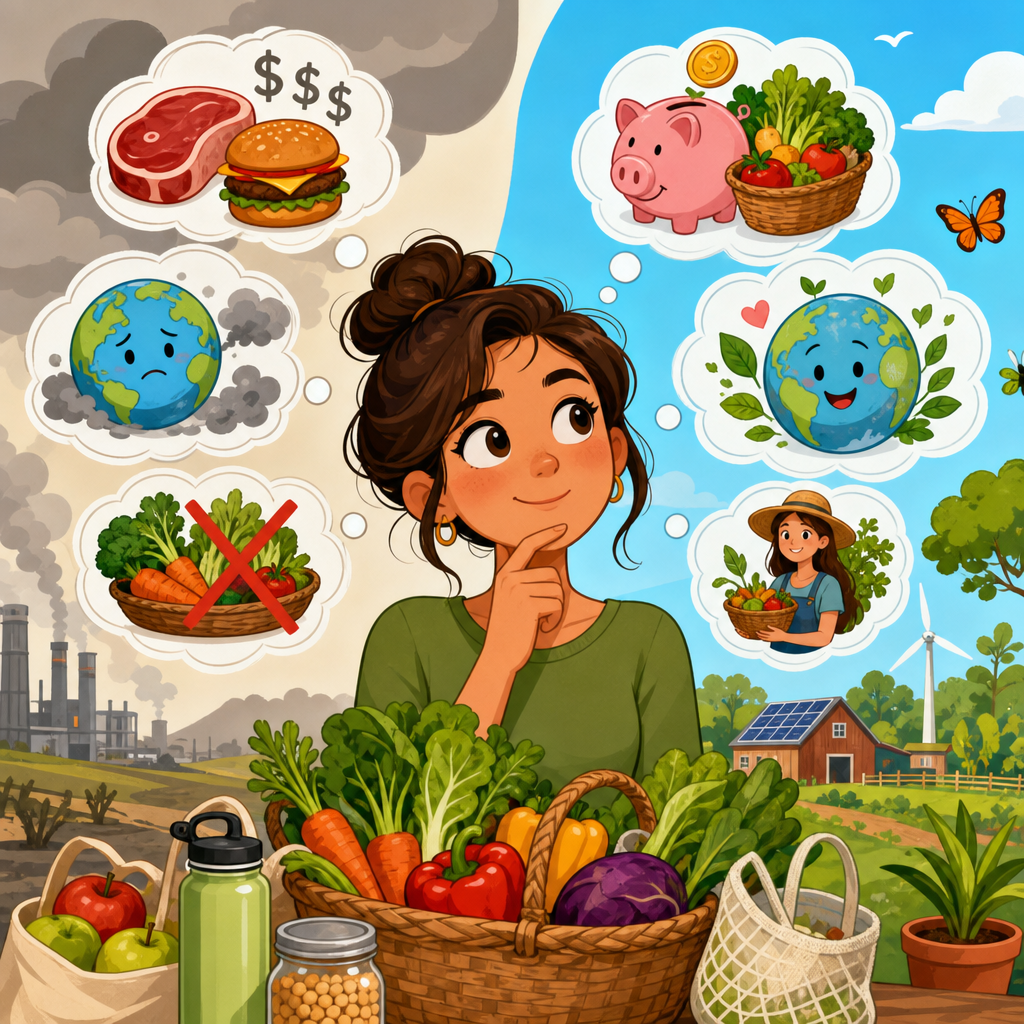
Ethical and sustainable food choices shape how food is grown, processed, transported, sold, and eaten, and they influence climate emissions, biodiversity, labor conditions, animal welfare, and public health. In practice, ethical food choices ask whether workers were treated fairly, animals were raised with lower stress and better care, and communities retained access to land and safe water. Sustainable food choices focus on whether a product can be produced today without undermining ecosystems or the food system’s resilience tomorrow. I have worked with food sourcing teams and sustainability reporting frameworks long enough to see one recurring problem: people want to make better decisions, but they are blocked by myths that oversimplify a complex system.
Those myths matter because food systems account for roughly one third of global greenhouse gas emissions, use about 70 percent of freshwater withdrawals, and remain a leading driver of deforestation and habitat loss. Yet the most sustainable option is not always the most expensive, local, or trendy one. Labels can help, but they can also confuse. Consumers hear claims about organic produce, regenerative agriculture, grass-fed beef, cage-free eggs, food miles, plastic-free packaging, plant-based diets, and seasonal eating, then try to reduce everything to a single rule. That is where mistakes happen. A useful hub page on ethical and sustainable food choices must define the terms clearly, answer common questions directly, and show where tradeoffs are real rather than imagined.
This article debunks the most common myths about ethical and sustainable food choices using practical examples, recognized standards, and plain-language reasoning. You will learn why local is not automatically lower impact, why packaging is not the whole story, why certifications are helpful but imperfect, and why reducing waste often matters as much as changing ingredients. The goal is not moral perfection. The goal is informed decisions that improve environmental outcomes, support fairer supply chains, and fit real budgets and households.
Myth 1: Local food is always the most sustainable choice
Local food can strengthen regional economies, preserve farmland, and improve freshness, but it is not automatically the lowest-impact option. In life-cycle assessment, transportation is only one part of a product’s footprint. For many foods, especially meat and dairy, production methods dominate total emissions. A tomato grown in a heated greenhouse nearby can generate more emissions than a field-grown tomato shipped from a warmer climate during its natural season. The same logic applies to lamb, dairy, and out-of-season produce. I have seen procurement teams assume a “buy local” policy solves sustainability, then discover energy-intensive production erased the transport savings.
Distance also tells you nothing about labor standards, water stewardship, or biodiversity. A nearby farm may still rely on overdrawn aquifers or poor worker protections, while a farther producer may operate under stronger environmental controls and audited social compliance. The better question is not simply “How far did it travel?” but “How was it produced, under what conditions, and in what season?” Choosing regional, in-season foods is often a strong strategy, but local should be treated as one decision factor, not a universal rule.
Myth 2: Organic means ethical, sustainable, and healthier in every way
Organic certification can reduce reliance on many synthetic pesticides and fertilizers and can support soil-focused farming practices, but it does not guarantee the best outcome across every ethical and sustainability metric. Organic standards vary by country, and certification mostly governs production inputs and methods, not the full social and environmental picture. Organic systems may still use tillage that increases erosion, depend on plastic mulch, import feed, or have lower yields that require more land per unit of food. Lower yields are not always a problem, but land use matters when habitat conservation is the goal.
Organic also does not automatically mean fair wages, excellent animal welfare, or superior nutrition. On nutrition, evidence generally shows modest differences at most, not a blanket rule that all organic food is more nutritious. On labor, separate fair trade or social compliance standards are often more relevant. On animal welfare, pasture access and stocking density rules may improve some conditions, but species-specific welfare outcomes still vary widely. Organic can be a valuable signal, especially when pesticide exposure or soil management is a concern, but it should be paired with questions about labor, water use, packaging, and overall diet quality.
Myth 3: Sustainable eating is too expensive for most households
This myth persists because premium products get the most attention. In reality, many of the highest-impact changes are affordable or save money. Reducing food waste, planning meals, storing perishables correctly, and using leftovers lower both household spending and environmental impact. Shifting some meals from beef and lamb toward beans, lentils, peas, tofu, eggs, or chicken often cuts costs significantly. Buying frozen vegetables, canned beans, whole grains, and seasonal produce is usually budget-friendly and sustainable. I have helped households audit grocery receipts, and the biggest wins almost never came from niche superfoods or upscale zero-waste stores.
Cost concerns are real, especially in areas with limited retail access, but sustainable eating does not require buying everything organic, local, or specialty-branded. It means prioritizing the choices with the strongest evidence behind them. If budget is tight, start with lower-impact proteins, more minimally processed staples, and a serious effort to prevent spoilage. Store-brand oats, rice, beans, peanut butter, carrots, cabbage, onions, and frozen spinach often outperform expensive “green” products in both value and impact. Equity matters here: ethical food systems must be accessible, not reserved for affluent consumers.
Myth 4: Plant-based automatically means sustainable
Plant-forward diets are generally associated with lower greenhouse gas emissions and lower land use than diets high in ruminant meat, but “plant-based” is not a free pass. A heavily packaged snack made from refined starches and imported oils may be plant-based yet still perform poorly on nutrition, waste, and sourcing concerns. Monoculture production can reduce biodiversity and strain soils or water resources. Some crops raise region-specific concerns, such as irrigation pressure in drought-prone areas or labor abuses in export supply chains. Responsible sourcing still matters even when the ingredient is not animal-derived.
That said, the broad evidence is clear: replacing a portion of beef and lamb consumption with legumes, soy foods, nuts, or grains is one of the most reliable ways to reduce dietary emissions. The key is not to chase labels but to focus on whole or minimally processed foods and balanced sourcing. Beans, lentils, tofu, tempeh, and peas are strong staples because they deliver protein efficiently with relatively low impacts. A sustainable plant-based pattern is built on diversity, not just meat substitutes, and it should consider worker conditions, water use, and processing intensity alongside carbon.
Myth 5: Packaging is the biggest environmental problem in food
Packaging is visible, so people often overestimate its share of total impact. In most food categories, the food itself accounts for far more emissions and resource use than the package around it. Beef, cheese, chocolate, coffee, and seafood all carry substantial upstream impacts from farming, feed, energy, land use change, or fishing practices. Throwing away a steak because the package was inconvenient is usually worse than buying the same steak in a recyclable tray. This does not mean packaging is irrelevant. It means packaging decisions should be evaluated in context.
Good packaging can prevent spoilage, contamination, and damage, all of which reduce waste. For perishable products, a lightweight plastic film may preserve freshness longer than a bulk bin or paper wrap. The better analysis weighs food waste risk, recyclability in the local system, material intensity, and reuse potential. In product development work, I have repeatedly found that redesigning portion sizes and date labels can reduce waste more than simply switching materials. If you want the biggest environmental return, first choose lower-impact foods and avoid waste; then optimize packaging where it truly improves recovery and shelf life.
Myth 6: Certifications are meaningless marketing tools
Certifications are imperfect, but dismissing them entirely is a mistake. Third-party standards can create measurable baselines for production practices, chain-of-custody controls, and auditing. USDA Organic, Fairtrade, Rainforest Alliance, Marine Stewardship Council, Aquaculture Stewardship Council, Certified Humane, and Global Animal Partnership each address different issues, and none covers everything. A seafood label may focus on stock management and ecosystem impacts, while a fair trade standard centers on producer terms and social criteria. Understanding scope is crucial. The label is not the whole answer; it is evidence tied to a specific standard.
The limits are equally important. Audit quality varies, smallholders can face high certification costs, and some standards are stronger than others. There are also outcome-versus-process debates: a farm may comply with required practices yet still have mixed real-world results due to climate, local ecology, or enforcement gaps. The practical takeaway is to prefer certifications with transparent criteria, independent verification, and public documentation, while recognizing that uncertified producers are not automatically worse. For many shoppers, certifications are the fastest credible shortcut available when full supply-chain data is inaccessible.
| Claim | What the evidence shows | Better rule of thumb |
|---|---|---|
| Local is always best | Production method often matters more than transport | Choose seasonal, lower-impact foods and check how they were produced |
| Organic covers everything | It addresses inputs, not every labor, welfare, or yield issue | Combine organic with fair labor and welfare signals when possible |
| Packaging is the main problem | Food production and waste usually dominate impacts | Prevent spoilage first, then improve packaging choices |
| Plant-based is automatically sustainable | Usually lower carbon, but sourcing and processing still matter | Favor diverse, minimally processed plant proteins |
Myth 7: Ethical food choices are only about the environment
Environmental performance is only one pillar of ethical and sustainable food choices. Human rights, farmworker safety, Indigenous land rights, animal welfare, and community food access are central ethical issues. A product can have a relatively low carbon footprint and still be linked to forced labor, unsafe working conditions, or unfair pricing for producers. Cocoa, coffee, seafood, and fresh produce are sectors where labor risks are well documented. In seafood specifically, the sustainability conversation increasingly includes vessel monitoring, transshipment oversight, and labor audits because ecological management alone does not prevent abuse.
Animal welfare adds another layer. “Cage-free” eggs, for example, may improve movement compared with conventional cages, but welfare outcomes still depend on flock management, stocking density, breed, air quality, and beak treatment practices. Beef promoted as pasture-raised may address some welfare concerns yet still carry high methane emissions. Ethical decisions require acknowledging these overlaps and tensions. There is no single perfect product, but there are better-informed priorities: avoid high-risk sectors without credible oversight, support suppliers with transparent labor and welfare policies, and understand that ethics extends well beyond carbon accounting.
Myth 8: Food waste is a minor issue compared with farming impacts
Food waste is one of the largest hidden drivers of unnecessary environmental damage. When food is wasted, all the land, fertilizer, feed, water, refrigeration, transport, and labor used to produce it are wasted too. The UN Food and Agriculture Organization has long estimated that roughly one third of food produced globally is lost or wasted. In emissions terms, wasted food is especially serious for high-impact items like beef, dairy, and shrimp. In household audits, I often find that salad greens, berries, bread, and leftovers are frequent waste categories, and each has a preventable cause such as overbuying, poor storage, or confusing labels.
Date labeling is a major source of confusion. “Best by” usually refers to quality, not safety. “Use by” may be more time-sensitive, but rules differ by product and country. Better storage, freezing, meal planning, and portioning routinely deliver larger sustainability gains than switching between similar brands. If a household reduces weekly waste by even a small amount, the annual savings in money and emissions are meaningful. Sustainable eating is not just about what enters the cart. It is about what actually gets eaten.
How to make better ethical and sustainable food choices in real life
The most effective approach is a hierarchy, not a purity test. First, cut waste. Second, shift protein choices toward lower-impact options more often, especially replacing some beef and lamb meals. Third, buy seasonal produce and rely on frozen or canned options when they prevent spoilage. Fourth, use certifications selectively for high-risk categories such as coffee, cocoa, seafood, and eggs. Fifth, support retailers and brands that publish sourcing policies, animal welfare standards, and progress reports with measurable targets. Transparency is a practical signal because companies willing to disclose methods are easier to hold accountable.
This hub on ethical and sustainable food choices should help you evaluate related topics with sharper judgment, from regenerative agriculture and food miles to fair trade, sustainable seafood, and low-waste kitchens. The central lesson is simple: broad claims rarely hold up. Local is not always best, organic is not a universal guarantee, plant-based is not automatically responsible, and packaging is not the whole story. Better choices come from looking at the full system: production, labor, welfare, seasonality, waste, and evidence-backed tradeoffs. Start with one or two changes you can maintain, then build from there. Consistent, informed decisions matter far more than chasing perfect labels.
Frequently Asked Questions
Is ethical and sustainable food always too expensive for the average shopper?
No, and this is one of the most persistent myths. Ethical and sustainable food choices can sometimes carry a higher price tag, especially for specialty products, but they are not automatically unaffordable. Cost depends on what you buy, where you shop, how often you cook at home, and which parts of your diet you prioritize. For example, buying seasonal produce, choosing legumes and whole grains more often, reducing food waste, and eating smaller portions of meat can make a food budget more affordable while still aligning with ethical and sustainable goals.
It also helps to understand what a higher price may reflect. In some cases, it accounts for better labor standards, improved animal welfare, more responsible land management, or farming practices that reduce pollution and protect biodiversity. Conventional food can appear cheaper because many environmental and social costs are not included at the checkout line. Soil degradation, water contamination, poor working conditions, and climate impacts are often absorbed elsewhere by workers, communities, and future generations.
The most practical approach is not perfection but prioritization. Shoppers can focus on a few meaningful changes, such as buying less but better meat, supporting local producers when feasible, choosing certified products with credible standards, or selecting foods with lower environmental footprints more often. Ethical and sustainable eating does not require an all-or-nothing lifestyle. Even modest, budget-conscious choices can contribute to a food system that is fairer, healthier, and more resilient.
Does buying local always mean a food choice is more sustainable?
Not always. “Local” can be a valuable factor, but it is not a guarantee of sustainability on its own. Transportation matters, yet it is only one part of a food product’s overall environmental footprint. In many cases, the way food is produced has a much larger impact than the distance it travels. Energy use, fertilizer practices, water management, land use, storage methods, packaging, and production scale can all outweigh simple food miles.
For instance, a locally grown product raised in an energy-intensive greenhouse may have a larger footprint than a field-grown product shipped efficiently from a region where it is naturally in season. Similarly, food transported by sea in large quantities can sometimes be more efficient than food moved shorter distances by less efficient methods. This is why sustainability should be evaluated across the full lifecycle of a product, not just by geographic proximity.
That said, local food can still offer meaningful benefits. It may support regional economies, improve transparency, strengthen community food systems, preserve farmland, and create shorter supply chains that make it easier to ask questions about labor practices, animal care, and production methods. A smarter way to think about the issue is that local can be a plus, but it works best when paired with other indicators such as seasonal production, responsible farming methods, fair labor conditions, and minimal waste. In other words, local is helpful, but not automatically the most sustainable choice in every case.
Is organic food automatically the most ethical and sustainable option?
No. Organic certification can signal important benefits, but it does not automatically make a product the most ethical or sustainable in every dimension. Organic standards typically address how food is grown and processed, often limiting synthetic pesticides and fertilizers and supporting practices that can improve soil health and reduce certain forms of pollution. Those are real advantages, especially when compared with highly chemical-intensive systems.
However, sustainability and ethics involve more than pesticide rules alone. A food choice may also involve labor protections, wages, land rights, water use, animal welfare, biodiversity outcomes, packaging, transportation, and the carbon footprint of production and storage. A product can be organic and still raise questions about worker treatment, excessive plastic packaging, long-distance transport, or inefficient resource use. Likewise, some non-organic farms may use integrated pest management, regenerative methods, water-saving practices, or strong labor policies that perform well on important sustainability measures even if they are not certified organic.
The key is to avoid treating any single label as a complete answer. Organic can be a useful indicator, but it should be considered alongside other factors and certifications. Looking for a combination of credible standards, transparency from producers, and evidence of responsible practices gives a fuller picture. Ethical and sustainable food decisions are usually about balancing multiple values, not relying on one label to do all the work.
Do individual food choices really make no difference unless governments and corporations change first?
This is a false choice. System-level change is essential, but individual choices still matter because they help shape demand, normalize better standards, and influence what retailers and producers are willing to supply. Consumer behavior alone will not solve climate emissions, labor abuse, biodiversity loss, or animal welfare problems, but it can be part of the pressure that drives broader transformation.
When enough people begin choosing products with stronger environmental and social standards, companies often respond by changing sourcing policies, expanding certified options, publishing more supply chain information, and setting measurable sustainability goals. Retailers track what sells. Food brands notice shifting preferences. Farmers and processors pay attention when markets reward lower-impact and more ethical methods. In that sense, personal decisions can contribute to collective momentum.
At the same time, it is important not to put the entire burden on individuals. Public policy, corporate accountability, labor protections, agricultural investment, and food access programs are all necessary to make ethical and sustainable choices easier and more affordable for everyone. The most realistic view is that both levels matter. Personal choices send signals and create cultural change, while institutions create the rules and infrastructure that can scale those changes. Rather than asking which matters more, it is better to recognize that meaningful progress usually comes from both working together.
Does eating sustainably mean everyone has to become vegetarian or vegan?
No. Plant-rich diets are often associated with lower environmental impacts, and reducing high-impact animal products can be one of the most effective ways to lower a food footprint. But sustainable eating is not limited to a single dietary identity. It is possible to make meaningful progress without becoming fully vegetarian or vegan, especially by focusing on frequency, sourcing, portion size, and overall dietary pattern.
For many people, a more sustainable approach might mean eating meat less often, choosing smaller portions, prioritizing producers with stronger animal welfare and land stewardship practices, and building meals around beans, lentils, grains, vegetables, nuts, and seeds more frequently. Different foods have different impacts, and those impacts vary depending on how they are produced. A blanket assumption that all animal products are equally harmful or that all plant-based products are automatically sustainable oversimplifies a complex issue.
Ethical questions also extend beyond emissions alone. They include worker conditions, water use, ecosystem health, cultural food traditions, access, affordability, and animal welfare. In some communities, animal foods may play important nutritional, cultural, or agricultural roles, especially where mixed farming systems support livelihoods and soil fertility. The goal is not to impose one universal diet, but to encourage choices that reduce harm and improve resilience where possible. In practice, the strongest message is that eating more thoughtfully matters. A shift toward more plant-forward, less wasteful, and more responsibly sourced meals can have a significant positive effect, even if a person does not eliminate animal products entirely.